
Cataract surgery is a minimally invasive procedure that involves numbing the eyes with anesthesia and then making a tiny incision into which an ultrasonic probe is inserted. The probe breaks up, or emulsifies, the cloudy lens into tiny pieces and then suctions them out of the eye. Once the cloudy lens has been removed, a new artificial lens is implanted into the eye. This lens is known as an intraocular lens (IOL), and can often be inserted through the same incision that the old lens was removed from.
Surgery usually takes only a few minutes to perform and is painless for most patients. After the procedure, a patch may be placed over the eye and you will be asked to rest for a while. Patients can return home the very same day, but will need someone to drive them home. For the next few days, you may experience itching, mild discomfort, fluid discharge and sensitivity to light and touch. Your doctor may prescribe eye drops to help the healing process and to reduce the risk of infection.
There are several different IOLs available to help each patient achieve the best possible results from his/her cataract surgery. Multifocal IOLs allow for full vision correction at near, intermediate and far distances, completely eliminating the need for eyeglasses or contact lenses in most patients. Some IOLs can also correct astigmatism.
These choices were not always available for cataract patients. In the past, cataract surgery only involved monofocal lenses, which could only focus on objects near or far, but could not adjust to accommodate varying distances. These patients still had to rely on glasses or contact lenses after surgery in order to see clearly at all distances. This was especially problematic in older patients suffering from presbyopia, a loss of flexibility in the eye’s lens that causes nearby objects to look blurry.
Laser Cataract Surgery

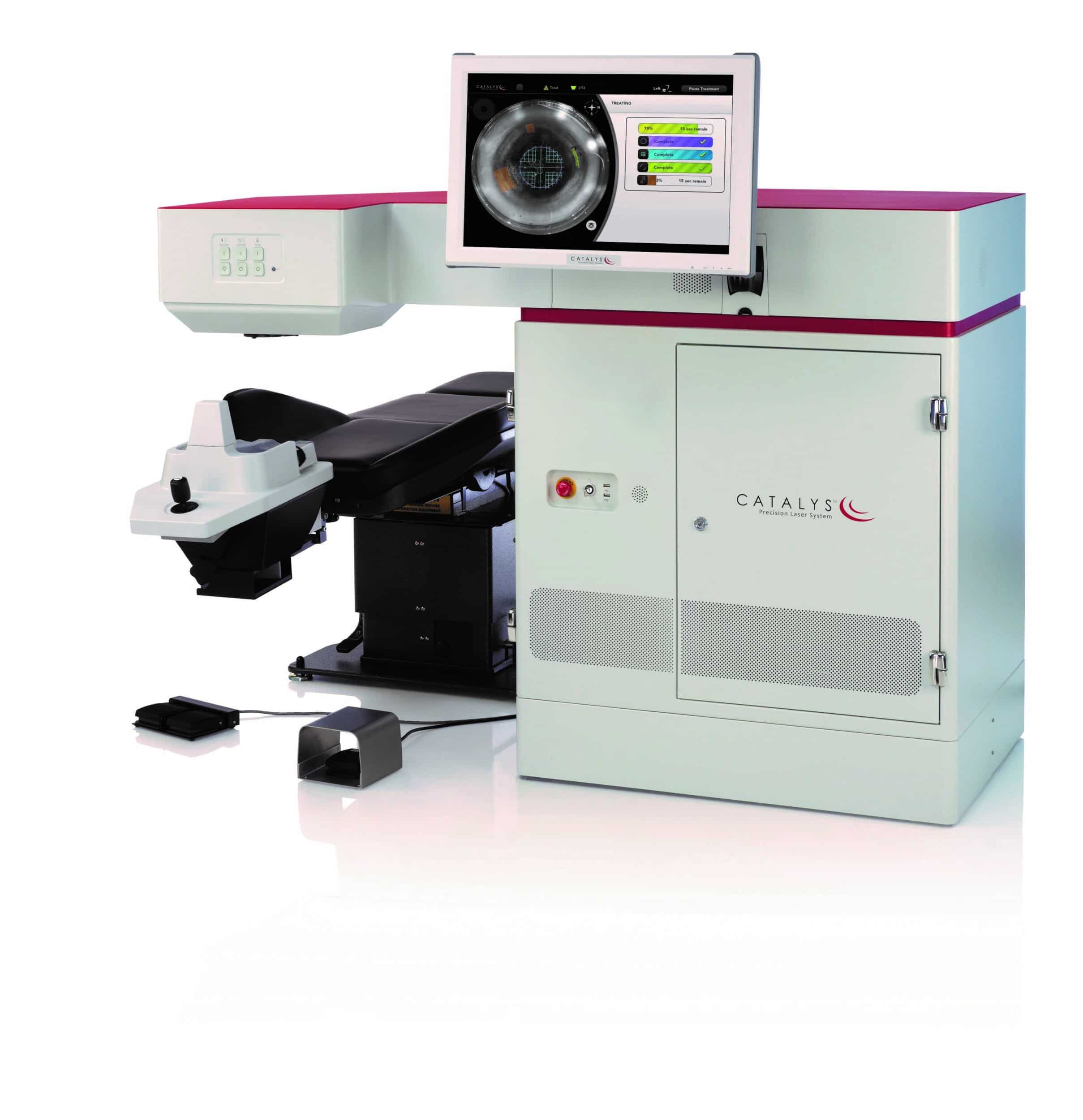
The CATALYS® Laser System is a technologically advanced laser designed to administer an extremely gentle cataract surgery that aids recovery time. And, as an advanced technology, it provides an unparalleled level of accuracy and precision to some of the more challenging steps of cataract surgery such as:
1. Capsulotomy – a centrally placed and tightly controlled circular incision allowing access to the cataract.
2. Lens Segmentation and Softening – treatment of the cataract itself to aid removal and minimize or eliminate ultrasonic energy delivered into the eye.
3. Arcuate Incisions or Limbal Relaxing Incisions – used to treat astigmatism. The laser can produce these within pockets to help offset dry eye conditions.
4. Cataract Incisions – precisely located and sized incisions normally done with blades to allow access to the cataract.
How Does The Laser Differ From Traditional Cataract Surgical Techniques?
Traditionally the eye surgeon uses blades to create incisions for lens treatment and removal. The laser uses computer guided imaging with over 10,000 scans to produce a highly detailed and customized image of your eye. This image is the basis for the treatment plan and laser control to produce incredibly precise incisions instead of manual incisions with blades.
Usage of the laser to pre-treat the lens prior to its removal can minimize and in many cases eliminate the usage of phacoemulsification (ultrasonic) energy used within the eye, minimizing ocular trauma and aiding recovery.
Astigmatism correction
Astigmatism is an irregular curvature of the cornea. When light enters the front part of the eye this irregularity can bend light in one direction more than another which can lead to a blurred, distorted vision. This condition can be treated with the CATALYS® Laser with the creation of Limbal Relaxing Incisions placed strategically to address the corneal irregularity.
Review this animation which highlights the differences of the CATALYS® Laser compared to traditional surgery:
For more Information on the CATALYS® Laser: Precision Laser Cataract Surgery
Learn how we can maximize your visual outcome and get you on the road to being glasses-free. Speak to our surgical staff to discuss implementation of a treatment plan tailored to your needs with the CATALYS® Precision Laser System.
Risk and Complications
If left untreated, cataracts will worsen over time and may lead to permanent vision loss or even blindness. It is important to see your eye doctor regularly in order to detect cataracts as early as possible and to plan an effective treatment method.
Although cataract surgery is considered safe, there are certain risks associated with any surgery. Some of these risks may include pain, infection, swelling and bleeding. However, most patients undergo this procedure without any complications.
Toric IOLs

Intraocular lenses are used to correct vision problems during cataract surgery by replacing the old, damaged lens with an artificial lens that clears up and corrects vision, often leaving patients with little to no dependence on glasses. While cataract surgery corrects cloudy lenses, it still leaves patients with astigmatism with distorted vision. Toric IOLs are specially designed to correct astigmatism along with overall vision during cataract surgery, offering complete vision correction.
Before Toric IOLs, people with astigmatism would need to undergo corneal refractive surgery after their lenses were implanted, or would remain dependent on glasses or contact lenses. The advanced Toric IOLs correct the imbalance caused by an irregular cornea shape in patients with astigmatism. There are several different types of FDA-approved Toric IOLs, including AcrySof® Toric Lenses, which can correct up to three diopters of astigmatism.
The risks of a Toric IOL include poor vision as a result of the lens rotating out of position, although this risk exists with any type of intraocular lens. Toric IOLs are considered safe for most patients with astigmatism and are the only solution to correct vision problems associated with both cataracts and astigmatism. Talk to your doctor to learn more about these lenses and find out if you can enjoy the benefits of Toric IOLs.
ReSTOR® Lens

Physicians have been using flexible IOLs for years to replace the eye's cloudy lens during cataract surgery and help patients enjoy clear vision again. The ReSTOR® lens improves upon the ordinary IOL by using apodized diffractive technology to provide a full range of focusing distances from near to far. A series of 12 gradual "step heights" of 0.2-1.3 microns each (thinner than a human hair and smaller than a red blood cell) in the center of the IOL create seamless focusing ability, while the peripheral refractive region helps to enhance distance vision. Apodization also allows the lens to work with the pupil to distribute light evenly in the eye in different lighting conditions and activity levels. Alcon® reports that up to 80 percent of patients who use the ReSTOR lens don't need glasses after surgery.
To learn more about our Cataract Surgery Services, please contact us at (703) 494-1766 today to schedule an appointment.